
USE OF ALVATECH 5002 GEOMEMBRANE FOR THE ERADICATION OF INVASIVE GIANT REED ALONG THE BANKS OF THE SEGURA RIVER
June 02, 2025
Location: Banks of the Segura River (Murcia and Alicante)
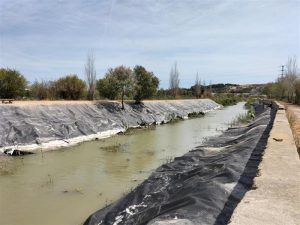
- 40,000 m² of 1.0 mm thick Alvatech HDPE Geomembrane for the riparian forest restoration project in the Segura River (Murcia)
- 35,000 m² of 1.5 mm thick Alvatech 5002 Geomembrane in the invasive species control project in Guardamar del Segura (Alicante)
Context
The giant reed (Arundo donax) is an invasive species that has extensively colonized the banks of the Segura River, especially in the Vega Baja region. This plant occupies up to 60% of the riverbed surface in some areas, displacing native species and reducing the river’s drainage capacity. Additionally, the giant reed has a high evapotranspiration capacity, consuming large amounts of water, which worsens the structural water deficit in the basin. In certain conditions, it can consume up to 40 liters/m² per day.
Sotrafa has previously supplied Alvatech 5002 Geomembrane for the eradication of invasive reed in several projects. Once again, during the first quarter of 2025, Sotrafa collaborated with TRAGSA on two major projects with the same goal: restoring the riparian forest in the Segura River and controlling invasive species in Guardamar del Segura.
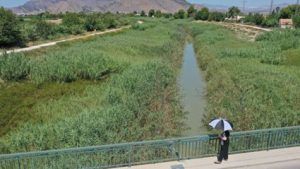
In warm areas like the Segura basin, during the active growth phase, this species can produce new non-lignified shoots of 50 cm in just one week and specimens of 2 meters after 30 days of active growth.
Challenge
Eradicating the invasive reed presents several challenges:
- Rapid proliferation: The giant reed has an incredible regeneration capacity, making cutting and removing it from the riverbed insufficient.
- Ecological impact: The reed displaces native biodiversity and consumes large amounts of water, even drying up surface water points under drought stress.
- Adaptation to semi-arid environments: The reed is especially adapted to semi-arid environments, making it difficult to eradicate.
Solution
To address these challenges, the use of Alvatech 5002 HDPE (high-density polyethylene) geomembrane, manufactured by Sotrafa, has been implemented. The process involves three main stages:
- Clearing the invasive reed: Using appropriate machinery, the surface reed is removed, although the roots (rhizomes) remain.
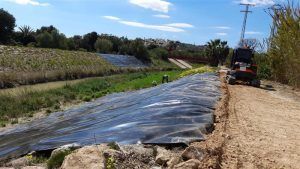
- Laying the Alvatech 5002 Geomembrane: The geomembrane is placed over the cleared slope, anchored at the top and secured with corrugated steel staples. The geomembrane suffocates the reed rhizome, eliminating it completely due to accumulated heat and gases generated by decomposition.
- Removal of the geomembrane and replanting of native flora: After a period of 8 months to 1 year, the geomembrane is removed and the treated surface is replanted with native species to support the river’s natural ecosystem.
The ALVATECH 5002 geomembrane is highly impermeable, with a hydraulic permeability of less than 1×10⁻⁶ m³/m²/day, blocking the reed’s access to water and nutrients and creating unfavorable conditions for its growth. Additionally, its tensile strength of 33 MPa and elongation at break of up to 850% ensure continuous and effective protection, preventing regrowth during the necessary period. Compared to other liners, it offers greater chemical resistance and durability, ensuring a longer service life. Its superior impermeability, tensile strength, and puncture resistance make the ALVATECH 5002 geomembrane the best alternative for applications requiring a robust impermeable barrier.